Online
Critical Analysis of the Creative Project (Student Yak) in Relation to Current
News Output
INTRODUCTION:
News is “something that is new or current …
it’s the things that people want to know about or need to know about” (Edwards,
2012). This critical analysis of the online news channel “Student Yak”, will
discuss the production of ‘Let’s Go Viral’, the definition of news, and the genre
of news and news production. To do this it will explore elements of news like
concept and brand development, audiences, platforms, presentation, storytelling
and story development. It will discuss how research from these key areas
influenced the creation, development, and production of Student Yak, and lay
out the reasons behind all the decisions that were made.
CONCEPT/BRAND DEVELOPMENT:
Student Yak is an online news channel that “aims
to find entertaining news and views from all corners of the Internet, and bring
it to [students]” (Student Yak, 2016). The channel focuses on the news it
believes is important to students, and does so using the ‘News as Infotainment’
method. This method relates to the “type of media which provides a combination
of information and entertainment” (Demers, 2009), which means the news is
presented in a fun and entertaining manner. It was decided that the programme
should focus on student news because as students, we felt we should report on
events that we found to be worthwhile. Chapman states “if news is to be
worthwhile, it should accord to something we value” (Chapman, 2009: 59), and we
believed students would value the stories we chose to focus on. Additionally,
with the popularity of other online news brands aimed at young people rising, for
example The Lad Bible being “followed by half of all 18-24 men in the UK”
(LadBible, 2015), we felt we had something we could offer with our new concept.
Branding in news is very important, as
Chapman explains the “style, structure and very look” (Chapman, 2009: 219) of a
news program is needed to “underpin their reliability and impartiality”
(Chapman, 2009: 219). One brand that influenced some of the decisions made on
Student Yak, is The Lad Bible, which uses the simple colours black and white
(fig. 1). By using a simple colour scheme, they come across as serious and
trustworthy. This influenced the choice of a simple colour scheme of purple and
orange for Student Yak (fig. 2), with purple representing power and ambition,
and orange representing enthusiasm, creativity and determination. These colours
are also bold and eye-catching, and will help maintain the interest of a
student, and help the brand stand out on social media.

Fig. 1. LadBible Logo (2015)

Fig. 2. Screenshot of Student Yak Logo (2016)
The overall feel of the Student Yak brand is
a relaxed and friendly one. We wanted it to be something not to serious that
students would enjoy watching. Student Yak isn’t supposed to be a formal news
programme, it is supposed to be a fun, light-hearted news programme that takes
a satirical look at the news, and we feel the brand choices made, with bright
colours, and an approachable feel, represent these intentions.
AUDIENCE RESEARCH:
An online news brand such as The LadBible
currently “reaches over 150 million people a week” (LadBible, 2015). With their
target audience being 18-24 year olds, it can be seen that this age range does
take an interest in the news, if it is reported in a manner that appeals to
them. Other online news brands aimed at students, like CNN Student News,
currently have over 1.1 million subscribers (YouTube, 2016), so again it
supports the idea that there is an audience out there for student based news. Student
Yak is aimed at a student audience that ranges from ages 18-30. This decision was
made based on a 2014 report on patterns and trends in UK higher education which
found that a “decline in mature students has resulted in a younger student
population” (Universities UK. 2014: 2), and that about 850,000 students are
aged 20 and under (Universities UK. 2014: 14). A digital news report from 2013
found that 50% of 18-44 year olds get their news online (Reuters, 2013). By
using this information, we decided that 18-30 year olds would be our best
audience, and an audience that would be most interested in what we had to say.
In terms of gender, we tried to aim for a balanced audience as a report from
2014 found that “56% of students were female” (Universities UK. 2014: 13), and
so aiming for a 50/50 audience appeared to be the best option.
NEWS AGENDA & BRAND VALUE:
As a news brand, we chose our own news
agenda, based on what we believed our audience wanted to know about. Chapman
said that a news brand is “responsible for constructing … news agenda” (Chapman,
2009: 75), and so as a news brand, we were responsible for choosing the right
news stories to bring to our audience. As well as us choosing our own agenda,
we also wanted our audience to choose it to by interacting with us on social
media, and by contacting us through our website. In the news industry, channels
such as BBC News encourage their audiences to share stories on their website.
They also encourage their audiences to get involved on social media, using
hashtags and twitter handles. Student Yak attempts to incorporate these methods
by having a contact us page on the website (Fig. 3) as well as social media
links in the video productions, and the video descriptions (Student Yak: Let’s Go Viral, 2016). This
allows the channel to be influenced by its audience’s opinions and helps us
decide what our agenda should be. Audiences of modern news productions benefit
from “relevant digital content [with] the introduction of alternate voices”
(Chapman, 2009: 44).

Fig. 3. Screenshot of Contact Us Page (2016)
PLATFORM RESEARCH:
In today’s world there is more “content
available anytime, anywhere on a wide variety of platforms” (Chapman, 2009:
43). The main platforms for news are print, radio, television and in more
recent years, online. A report from 2013 found that although “digital may be
impacting traditional platforms [it is] not yet replacing them” (Reuters,
2013), as 77% of mobile users still use TV news as their main news source
(Reuters, 2013). Using an online platform for a news channel works in its
favour as it doesn’t have to reach millions of viewers in order to stay on air,
and it doesn’t have to follow the same guidelines as TV news, although that
could be a negative. A recent episode of CNN Student News only reached about
12,000 people (CNN Student News- The
Dangers of Distracted Driving, 2016) and a month later they’re still
producing daily episodes because views are not as important as they are in
television news. As well as this, “digital broadcasting has a far cheaper cost
of entry and offers interactivity” (Chapman, 2009: 44), and although you can
have interactive television, it can be hard to lower the costs involved.
Using YouTube as a platform for news broadcasting
comes with many benefits. YouTube has about 22.7 billion visits a day (SimilarWeb,
2016), and “reaches more 18-34 and 18-49 year olds than any cable network in
the U.S.” (YouTube, 2016). It is clear that many people visit and use YouTube
on a daily basis, thus it has a lot of potential as a platform for digital news
broadcasting. Add to this the ability to have interactive features like video
cards, and social media links, and the ability to broadcast live, it’s clear
that YouTube has many of the features associated with news reporting, whilst
maintaining an interactive connection with the audience. Many major news brands
like BBC News, and CNN have their own YouTube channels, and YouTube itself has
a channel dedicated to bringing together news related videos from across the
platform (YouTube, 2016).
CITIZEN JOURNALISM:
In recent years, with the constant
development of mobile devices, and data connectivity, Citizen Journalism has
been on the rise. Bowman and Willis state that it is based upon citizens
“playing an active role in the process of collecting, reporting, analysing, and
disseminating news and information” (Bowman and Willis, 2003). It involves
people “without professional journalism training … [using] tools of modern
technology and the global distribution of the Internet to create, augment or
fact-check media” (Glaser, 2006). In recent years YouTube has played an
important part in providing a platform for citizen journalists, and so we
decided to use it as the main platform for Student Yak. As well as this, it
gave us the chance to mix the traditional elements of news reporting, with the
elements that have come about as a result of digital news reporting, like
social interaction through Twitter and Facebook.
NEWS PROGRAMME STUDIO/SET DESIGN:
Across all platforms and news genres, the
presentation of the news plays an important part in helping an audience
understand the story that is being told. It can be argued that if news channels
focus too much on presentation and how other channels present the news they
could be acting without “any proper consideration of what [they] should be
doing” (J’accuse The News, 1994). In
terms of locations, TV news tends to use studio sets, and digital news programs
tend to use green screens. This may be because for smaller productions, like
those seen online, using a green screen is a quicker and cheaper option. One
online news production, CNN Student News, uses a green screen studio for all
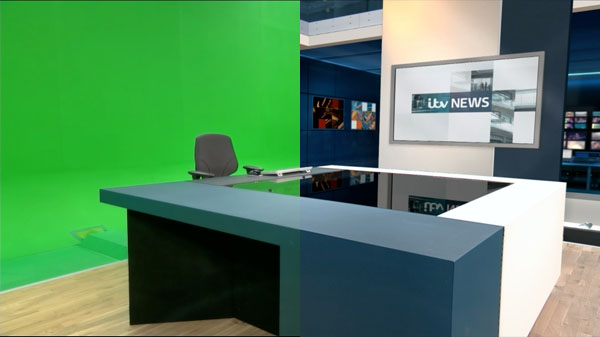
the segments with the main presenter (fig. 4). On television news, a studio set
is traditionally used, however ITV News uses a very convincing green screen set
(fig. 5), combined with some physical set elements. The CEO of FX Design Group,
Mack McLaughlin has said “Someday … more sets will be virtual … they’ll look
real enough and the cost of materials and shipping will be such that it doesn’t
make sense to … build scenery” (Dodson, 2013). This could explain the use of
green screen in digital news broadcasting; it’s cheaper. For Student Yak, we
decided to use a green screen, and digitally add in a studio set. We wanted the
audience to learn a bit about the behind the scenes aspect of television, and
so our digital studio set has television cameras, and lights in view (fig. 6),
a method also used by BBC News (fig. 7.).

Fig. 4. Screenshot from CNN Student News (2016)

Fig. 5. ITV News split screen (2013)

Fig. 6. Screenshot from Student Yak: Let’s Go Viral (2016)

Fig. 7. Screenshot from BBC Weekend News (2016)
GRAPHICS AND DESIGN:
Student Yak also used a lot of on screen
graphics, however, we didn’t make this decision because of the “need to have
constant activity on screen” (J’accuse
The News, 1994), we did it because we felt it’d be the best way to
represent information and the best way to keep our student audience engaged. We
also felt it fit with the news as infotainment method we were trying to follow.
As well as this, we were also following the idea that “if there are no
pictures, … there is no story” (Chapman, 2009: 98).
SCRIPTING AND STORYTELLING CONTEXTUAL RESEARCH:
For Student Yak, we chose the rise in the
popularity of viral videos as our news peg. A news peg is defined as “an aspect
or angle of a story that makes it newsworthy” (Oxford Dictionaries, 2016).
After some research we found that the viral video ‘Charlie Bit My Finger’ had
been “viewed almost 177 million times” (Hoby & Lamont, 2010). We believed
this information made a story about viral videos newsworthy, and so we decided
to answer the question ‘how do you go viral?’. For our news package we decided
to give our audience a step by step guide to going viral, based on the research
we had carried out, and for our live package we decided to attempt to go viral
by trying to break a world record. We felt this was the best way for us to
approach our news peg, and we believed it would maintain the interest of our
target audience, and engage with them.
For the final production we looked at the
reporting style of major news programmes to decide how we should represent the
story on camera. For example, BBC Weekend News uses a studio presenter to
introduce each story and give a ‘coming up’ before the programme begins (BBC Weekend News, 2016). They then use
additional presenters/reporters in the news packages to expand on the studio
introductions. As well as this, they also use live link ups to allow the
presenter and the reporter to further expand on the story. And finally, they
also use GFXs to represent information that is being spoken about during the
reports (BBC Weekend News, 2016). For
Student Yak we used studio introductions, pieces to camera, GFXs, and
interviews to represent our story in a similar way to that of a news programme such
as BBC News or CNN News. For the interview we spoke to a YouTuber as we felt
they’d be the best person to gather information from regarding the world of
online videos. For the live segment, we chose to use students as our
contestants, as they were the types of people we were targeting for the overall
programme. We also chose to only use student presenters for the same reason.
CRITICAL REFLECTION & CONCLUSION:
Student Yak resulted in an entertaining,
visually engaging, and informative digital news programme, which, based on
research, represents the audience it is aimed at. Although it doesn’t follow
the same conventions as traditional TV news, it is still structured in the same
manner and still uses the same tools, like studio set ups, pieces to camera,
and interviews. By introducing social media into our digital news production, we
have allowed our audience to contribute to our news, and we have showed them
that we care about their opinions on the news stories we report.
In terms of weaknesses, I feel that Student
Yak could try not to rely on comedy and gimmicks too much, otherwise this will
make it harder to report on serious news stories if we ever had too. Although
the decision to include comedy was made because of our target audience, I feel it
could be toned down a little, so the audience can still focus on the importance
of the stories we are trying to tell. If you look at professional, well
respected and trustworthy news brands such as BBC News, they always look at the
news with a serious mind-set, however to do like to end with a happy,
light-hearted story (BBC Weekend News, 2016).
I think we made a good choice by deciding to
focus our attention on branding and social media, as a lot of TV news brands
are also now focusing on social media. I also believe by doing this, it allowed
us to expand on the entertainment value of Student Yak, and therefore follow
the method of news as infotainment. Overall, because of the decisions we made
in terms of concept, branding, audience, platform, presentation, news stories,
and structure, Student Yak fits with the typical conventions of the news genre
and news programmes, whilst applying the modern and interactive elements that
broadcasting using a digital platform allows for.
ILLUSTRATIONS:
Figure 1. LadBible Logo (2015) [Logo] At: http://ichef-1.bbci.co.uk/news/640/media/images/80801000/jpg/_80801404_80801403.jpg
(Accessed on 19.11.16)
Figure 2. Screenshot of Student Yak Logo (2016) [screenshot] At: http://studentyak.wixsite.com/studentyak
(Accessed on 19.11.16)
Figure 3. Screenshot of Contact Us Page (2015) [screenshot] At: http://studentyak.wixsite.com/studentyak/contact-us
(Accessed on 19.11.16)
Figure 4. Screenshot from CNN Student News (2016) [screenshot] At: https://www.youtube.com/watch?v=ZVFYwlv_YJ0
(Accessed on 19.11.16)
Figure 5. ITV News split screen (2013) [image] At: http://www.kojoboateng.com/wp-content/uploads/2013/01/ITVNews_Splitscreen-copy.jpg
(Accessed on 19.11.16)
Figure 6. Screenshot from Student Yak: Let’s Go Viral (2016) [screenshot] At:
https://www.youtube.com/watch?v=QSQJaHz2I4A
(Accessed on 19.11.16)
Figure 7. Screenshot from BBC Weekend News (2016) [screenshot] At: http://www.bbc.co.uk/iplayer/episode/b0827rs3/bbc-weekend-news-20112016
(Accessed on 19.11.16)
BIBLIOGRAPHY:
Books
Chapman, Jane (2009) Broadcast Journalism: A Critical
Introduction. London: Routledge.
Demers, David (2009) Dictionary of Mass Communication and Media
Research: A Guide for Students, Scholars and Professionals. US: Marquette
Books.
Articles
BBC
Weekend News [news program] Pres. Brown. BBC News (2016) 20 mins.
At: http://www.bbc.co.uk/iplayer/episode/b0827rs3/bbc-weekend-news-20112016
(Accessed on 19.11.16)
Bowman, S. and Willis, C. (2003) We Media: How Audiences are Shaping the
Future of News and Information. At: http://www.hypergene.net/wemedia/weblog.php
(Accessed on 19.11.16)
CNN
Student News- The Dangers Of Distracted Driving [online news
program] Pres. Azuz. CNN (2016) 10 mins. At: https://www.youtube.com/watch?v=ZVFYwlv_YJ0
(Accessed on 19.11.16)
Dodson, A. (2013) Green Screen Not Just For Weather Anymore. At:
http://www.tvnewscheck.com/article/69033/green-screen-not-just-for-weather-anymore
(Accessed on 10.12.16)
Edwards, H. (2012) What is news?: transcript. At: http://news.bbc.co.uk/1/shared/bsp/hi/pdfs/071011huw_what_is_news.pdf
(Accessed on 10.12.16)
Glaser, M. (2006) Your Guide to Citizen Journalism. At: http://mediashift.org/2006/09/your-guide-to-citizen-journalism270/
(Accessed on 19.11.16)
Hoby, H and Lamont, T. (2010) ‘How
YouTube Made Superstars Out of Everyday People’. In: The Guardian [online]
At: https://www.theguardian.com/technology/2010/apr/11/youtube-web-video-stars
(Accessed on 18.11.16)
J’accuse
The News [television programme online] Pres. Pearson. Channel 4
(1994) 25 mins. At: https://estream.ucreative.ac.uk/view2.aspx?id=9642~4v~6hmQEK79
(Accessed on 20.11.16)
LadBible. (2015) Our Mission & Our Company. At: http://www.theladbiblegroup.com/about/
(Accessed on 19.11.16)
Last
Ever 60 Seconds on BBC Three [online video] Pres. Naz. BBC News
(2016) 3 mins. At: https://www.youtube.com/watch?v=_TJ7dthfC3U
(Accessed on 19.11.16)
Oxford Dictionaries. (2016) Definition of News in English. At: https://en.oxforddictionaries.com/definition/news
(Accessed on 19.11.16)
Oxford Dictionaries. (2016) Definition of News Peg in English. At: https://en.oxforddictionaries.com/definition/us/news_peg
(Accessed on 19.11.16)
Reuters. (2013) Digital News Report 2013: Executive Summary and Key Findings of the
2013 Report [online] At: http://www.digitalnewsreport.org/survey/2013/executive-summary-and-key-findings-2013/
(Accessed on 19.11.16)
SimilarWeb. (2016) Youtube.com Analytics. At: https://www.similarweb.com/website/youtube.com
(Accessed on 19.11.16)
Student Yak. (2016) Student Yak: About Us. At: http://studentyak.wixsite.com/studentyak/about-us
(Accessed on 19.11.16)
Student
Yak: Let’s Go Viral [online news program] Pres. Jones. Student Yak (2016)
7 mins. At: https://www.youtube.com/watch?v=QSQJaHz2I4A
(Accessed on 19.11.16)
Student Yak. (2016) Student Yak: Contact Us. At: http://studentyak.wixsite.com/studentyak/contact-us
(Accessed on 19.11.16)
Universities UK. (2014) Patterns and Trends in UK Higher Education. At:
http://www.universitiesuk.ac.uk/policy-and-analysis/reports/Documents/2014/patterns-and-trends-in-uk-higher-education-2014.pdf
(Accessed on 19.11.16)
YouTube. (2016) CNN Student News on YouTube. At: https://www.youtube.com/channel/UCFaCoQm2VArZof_egvYRVLA/about
(Accessed on 19.11.16)
YouTube. (2016) YouTube Channel: News. At: https://www.youtube.com/channel/UCYfdidRxbB8Qhf0Nx7ioOYw
(Accessed on 19.11.16)
YouTube. (2016) YouTube: Statistics. At: https://www.youtube.com/yt/press/statistics.html (Accessed on 19.11.16)