Thursday, 5 May 2016

Documentary: Louis Theroux (Documentary Filmmaker)

As part of my pre-production for the documentary unit I have chosen to look at the documentary filmmaker: Louis Theroux

LOUIS THEROUX


A bit of background info...


Louis Theroux is a British documentary filmmaker. He is best known for his Gonzo style journalism, that tends to favour style over accuracy and often uses personal experience and emotions to provide contract for the topic or event that is being documented. Theroux tends to only work with the BBC and over his career has produced numerous stand out documentaries like Louis Theroux's Weird Weekends, and in more recent years Transgender Kids, and Drinking to Oblivion.


When looking at Louis Theroux I decided to focus on his interviewing style, as I think this is one of the main reasons his documentaries are as interesting as they are. If it wasn't for his interviewing style, he probably wouldn't get as much information as he does. I think Louis presents himself to interviewees as being a bit naive. The way he presents himself, makes the interviewees feel as though they have to tell him everything, starting with the basics, which ultimately is an advantage because then the audience get a very clear picture of the subject. This naive manner also allows him to make the interviewee feel comfortable before he suddenly switches and starts asking tough questions which make them feel uncomfortable. He starts with typical, open questions that allow the interviewee to talk freely about the topic, before he begins to ask specific, quick fire questions that, in a way, lead the interviewee into revealing all the information they can, which can be useful when talking about difficult subjects.

I find Louis Theroux interesting because when he has to spend time with his subjects, he actually takes an interest in what they are doing and doesn't question them too much. For example, in one of his documentaries he spends some time with an ex-crystal meth dealer. During his time in this mans home, he builds a rapport with him and his friends and allows them to show him around and show him what they do. Instead of asking his tough questions, he only ask a few off topic questions, and tries his best to take an interest in their lives. By doing this he is able to build up a good relationship with his subjects, which will make them more likely to answer his tougher questions further down the line.

One of the things he does well is identifying his subjects weaknesses. As bad as it sounds, it appears as though he uses these weaknesses to get to his subjects and to make them open up a bit more. For example, in one of his documentaries, a subject his is following, breaks down and begins to open up to him when he starts asking about her children. It is clear that her relationship with her children made her open up. Louis also likes to put people on the spot and force them to explain their actions, which often leads to people saying some really interesting things on camera, things they wouldn't normally want to admit.

Overall, I like Louis's interview style, because it allows him to get access to people who wouldn't normally give access. Because of his somewhat friendly and naive manner, he can build up a relationship and make people feel more comfortable sharing delicate information with him. I respect this style, however, because now hard hitting questions will really be used when filming my documentary, it's not a style I will take on myself. I will be friendly with the subjects, but that won't be because I am planning to hit them with hard questions further down the line.


Images:

http://i.telegraph.co.uk/multimedia/archive/03239/louis_3239909b.jpg

Documentary: The Supervet (Documentary TV Series)

As part of my pre-production for the documentary unit I have chosen to look at the documentary television series: The Supervet

THE SUPERVET

The Supervet
is a UK factual entertainment television series created by Channel 4 that follows vet Noel Fitzpatrick and his team at Fitzpatrick Referrals in Surrey. The program focuses on the extraordinary work Noel and his team carry out at the practice, treating animals from across the country, and carrying out life saving treatments and surgery. Noel and his team dedicate their time to saving the lives of pets that would otherwise be beyond saving, and Noel has become known as 'The Bionic Vet' because of all the new techniques and surgeries he has come up with. The filming style of the program, using handheld cameras and fixed rigs around the location, allows them to capture everything that goes on inside the practice, making for an entertaining, and often heartbreaking watch.
Noel and one of his patients
In preparation for this blog post, I watched the latest episode of the program and made some notes on what I could see and hear, in terms of how the program is put together. I have actually been watching The Supervet since it began in 2014, and so I have a good idea of how it has developed over the last 2 years.

I'm going to start off by talking about the narrator as she plays an important part in the program. The show is narrated by Rebecca Front, a British actress and writer. Right from the start of each episode her voice is very prominent. The program begins with a small opening title, lasting just over a minute, that sets up the location, characters, and theme/style. Her accompanying voice over is the element that actually introduces everything, especially the location: "Deep in the heart of the Surrey countryside". As the narrator her role includes setting up each story, and each section of every episode. This is often done by using the time of day as a set up: "It's two thirty a.m. and...". As well as this, she also helps to explain some of the surgery scenes, with Noel backing her information up with what he is saying to the camera during the actual surgery. This helps the audience understand what is going on because, unless you are a vet or a doctor, some of the visuals do not speak for themselves. Along these lines, Rebecca also talks about some of the equipment that is being used on screen: "The state of the art scanner produces 3D images of Archie's leg and body". She will then go on to explain how this will aid Noel: "It will help establish whether his cancer has spread". This again helps the audience understand the process Noel and his team must go through to establish what the issue is so they can fix it. Often Rebecca's voice over is backed up using clips from interviews with the characters featured in the stories. It is clear that overall the narrator plays an important part, and unlike most over programs I have seen of this type, the narrator speaks a lot, not just between sections but also during them.

Next I'm going to talk about the interview style. The show uses two different styles and it depends on the situation. During the scenes at the surgery, everything is filmed handheld. The people who bring the animals in are often interviewed in the carpark after their visit, and this is usually cut into the program after they have handed their pet over to Noel. During the scenes set inside the pet owners homes, that normally appear as part of the recovery or backstory parts of the program, all the interviews are filmed static, with the subject sitting in their home. I beleive these two different styles are used because, once the production team have filmed all the characters and their pets, they have time to pick and arrange to come back to certain characters homes to film a formal interview to help fill gaps in the edit, and to give them a chance to ask more questions. They wouldn't want to waste money filming formal interviews with characters that won't end up in the final edit. And I also beleive that during the initial filming, because it is actuality based and they are purely following someone that has turned up on the day, they don't have time to arrange to film a formal, sit down interview either in the practice, or in a studio, and so they film them on the fly, asking the characters to just talk about what has happened. And finally, there is another use of formal, sit down interviews in this program. Often, if a section of the program is focusing on the staff at the practice, they will cut in formal interviews they have filmed with the staff. During these interviews it seems as though they have asked the characters to talk about all sorts of different things so they can use clips from just one interview with each character, across the entire series, each time focusing on a different topic. These interviews seem to be conducted either in an actual surgery room, or a studio that has been dressed up.
Example of the handheld car park interviews
Example of the formal interviews with characters
Example of the formal interviews with staff
When looking at sound, it can be noted that is program does have it's own style, especially when it comes to music. The music used throughout is often very light and bubbly, and mainly played by orchestral instruments (strings, woodwind). Occasionally, the music can add to the emotion or tension of a scene, making it easy for the audience to really connect with the action on screen. The music was often used during the gaps between sections, and during emotional scenes, like when Noel is talking to the pet owners about the problem, and during the surgery scenes, to add to the tension. In terms of normal sound, it appears that Noel, as the main character, is always mic'd up, so nothing he says is missed. Occasionally, it sounds like at least one of the pet owners is mic'd up, but most of the time it sounds as though the audio is picked up by a camera mounted mic. From my research it doesn't seem as though this program uses boom operators. I think these two sound choices, both clip mics, and on camera mics, make shooting actuality a lot easier, hence why they chose to do it like that.

In terms of visuals, the program uses mostly actuality shots and interviews to tell the stories. Gaps between sections are filled with GVs of the exterior, the waiting room, or during surgery, the operating theatre. All lot of the GVs are very crisp and clear, with a nice depth of field, and very interesting colour. The GVs play an important part in helping set the scene, and so they do often change depending on the time of day (either day or night). Many of the GVs are exteriors, and focus on the wide amounts of countryside surrounding the location. Time-lapse shots are often used to show a change in time. These time-lapse shots are often very cinematic, and the night time ones are beautiful; obviously shot on a clear night as all the stars in the sky are visible. All actuality is shot handheld, and there isn't really any sequences made up of staged or directed shots. GoPro's are occasionally used to give the audience a different perspective of something. During the opening sequence some drone footage of the location is used. When looking at on screen titles, it can be seen that they all follow one design: a light, easy to read font, in white, with a slight glow (as seen in one of the screenshots above). During surgical scenes, the camera will often focus on Noel's hands, or face, and they don't shy away from showing all aspects of the surgery, no matter how graphic. Because the program is also filmed using remote fixed rig cameras set up around the location, they often have multiple angles for one scene. When Noel is in the consultation room talking to pet owners, one handheld camera focuses on him and the action in the room as a whole, whilst one remote camera by his desk focuses on the pet owner and their pet. Overall this visual style, and this use of multiple techniques, adds to the realness and emotion of the program.

The opening drone shot
A shot from one of the many remote cameras
A GoPro shot
A close up on Noel's hands
Example of a GV
Example of handheld and remote cameras being used together
And finally, the structure of the program. The show starts with an opening title sequence that sets the program up, introducing Noel and his team, as well as the location and style of the program. Then it begins with the first and second story, before the ad break. Throughout the course of the episode the three or four stories feature are all woven together, with the last story to conclude usually being the one that opened the episode. Between stories, little 'moments' are used to fill the gaps. This could sometimes be something that goes on with the receptionists, or something that goes on with the other vets and staff. These 'moments' are often quite humorous and help break the tension and emotion the program possesses. The final part of the program usually ends with a happy outcome, before moving on to a 'next time' segment that sets up the next episode. This structure is pretty consistent across all episodes, and is similar to that of most factual entertainment type documentary TV series.

From my research into The Supervet I have learnt a lot about the structure, visuals, and audio aspects of documentary filmmaking. I have learnt that the narrator plays an important role when there is no presenter, just characters. I have also learnt that GVs are important in setting the scene, and filling the gaps. And finally I have learnt how important it is to film actuality handheld, and not to worry about how good it looks, as long as you capture what needs to be captured. I will take all of this new information on board when thinking about how to directed my documentary.

Images:

Screenshot from: https://www.youtube.com/watch?v=f8MIDkZs_4g
http://www.fitzpatrickreferrals.co.uk/wp-content/uploads/2010/02/noel-with-dog-1140x760.jpg
Screenshots from: http://www.channel4.com/programmes/the-supervet/on-demand/61543-015

Wednesday, 4 May 2016

Documentary: Location & Edit Workshop

As part of the pre-production for the documentary unit I took part in a location and editing workshop.

LOCATION AND EDIT WORKSHOP

For this workshop we were given the chance to spend a day in Faversham, filming the market and creek. The purpose of the workshop was to allow us to show that we can work safely on a location, and work in a public location, filming many different subjects.

FILMING

For this workshop I worked with Nisserin and Rebecca. We started the shoot off by setting the equipment up and starting at the furthest end of the market. We then moved down the market, with me filming as much as possible. After a little while, I handed the camera to Nisserin, who continued to do the same. We all kept a lookout for things to film, pointing out any interesting shots.

During the filming, we ended up filming a few shots of a musician playing a guitar in the main square. After filming him for a little while, Nisserin went over to him and asked him if he wouldn't mind signing a consent form, so we could use him in our final edit.

After this I took the camera back and continued to film some more footage, this time of the main square. We spent some time here filming the stalls and the customers browsing. Later on, we moved further down the high street, trying to find more things to film.

Realising that there wasn't much left to film on the high street, we headed over to the creek. On our way to the creek we bumped into a nice man who offered to be interviewed on camera. He was the owner of a local restaurant and so during his interview we asked him about the business. After the interview we filmed a couple of GVs outside the restaurant. Then we moved onto the creek. We stood on a bridge that ran over the creek and filmed a few wide shots of the area. Knowing we were coming back later on, we didn't spend too long there before heading back to the main square. On our way back to the square we filmed some shots of the brewery.

After lunch we headed back down to the creek. We handed the camera over to Rebecca so she could film some shots of the area. Nisserin and I helped out by suggesting a few interesting frames. By this point our card was almost full, and so we tried to make every shot count. Near the end of the shoot, a goose came very close to where we were filming. At one point it even came ashore to get a closer look. Rebecca captured the whole thing on camera and it made for a good watch.

By the end of the shoot, we had filled the card, which meant we had filmed almost 60 minutes of footage.

EDITING

As part of the editing process, Nisserin and Rebecca put together a cut of the film, using all the footage we shot during the workshop. They then handed it to me and I fine tuned some of the edits, adjusted the sound levels, and added some titles.

Here is the final version-


After a group viewing, here was the feedback we received-
- The framing was nice.
- The narrative worked.
- The market section was the strongest and most interesting.
- The music didn't really fit.
- Not all the shots were in focus.
- We should have used a tripod more.

This workshop taught me a lot about filming this kind of footage. It was clear that the best thing to do was to just film anything and everything. The best thing to do was to just keep an eye out for anything that could be used to help the narrative of the documentary. I learnt a lot from this workshop, in terms of filming and I'm happy with the outcome.

Monday, 2 May 2016

Documentary: Shot List

As part of the pre-production for the documentary unit, I created a shot list for the three planned filming days.

SHOT LIST

To create the shot list, I used all the information I could get from the story outline and the second draft of the script. This shot list will help whoever is filming because it will give them an idea of the shots we need to successfully tell the story we are trying to tell. It also gives some information of framing, which can also be very important when shooting actuality.

On the shot list, I have also included information on some additional footage that will be needed from other locations for us to be able to tell this story, and to ensure we can fill some gaps in the edit.

The shot list is quite long so I have only included the first three pages:

Page 1
Page 2
Page 3

Documentary: Call Sheet & Schedule

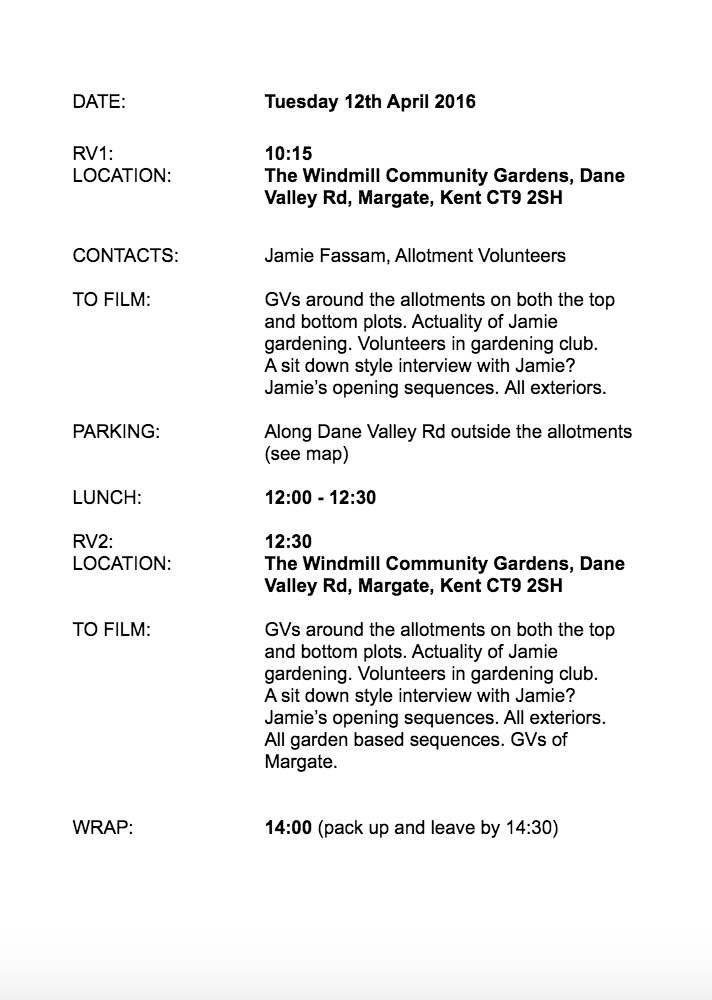
As part of the pre-production for the documentary unit, I put together a call sheet and schedule for the three filming days we had secured on our location.

CALL SHEET AND SCHEDULE

The call sheet and schedule are important to ensure everything happens when it needs to. It will help the crew know where they need to be and when they need to be there. On the first two days the call time isn't too early, however on the last day the call time is quite early. The call sheet also explains what will be shot each day, so the crew know how to prepare for each shoot. The call sheet and schedule also contain other information like:

  • Everyone contact details (crew/characters/UCA staff)
  • Information on nearby hospitals; places to get food; dress code; and transport
  • Important locations on a map of the area
Hopefully everything goes to plan.

Page 1

Page 2
Page 3


Page 4


Page 5

Page 6

Documentary: Risk Assessments

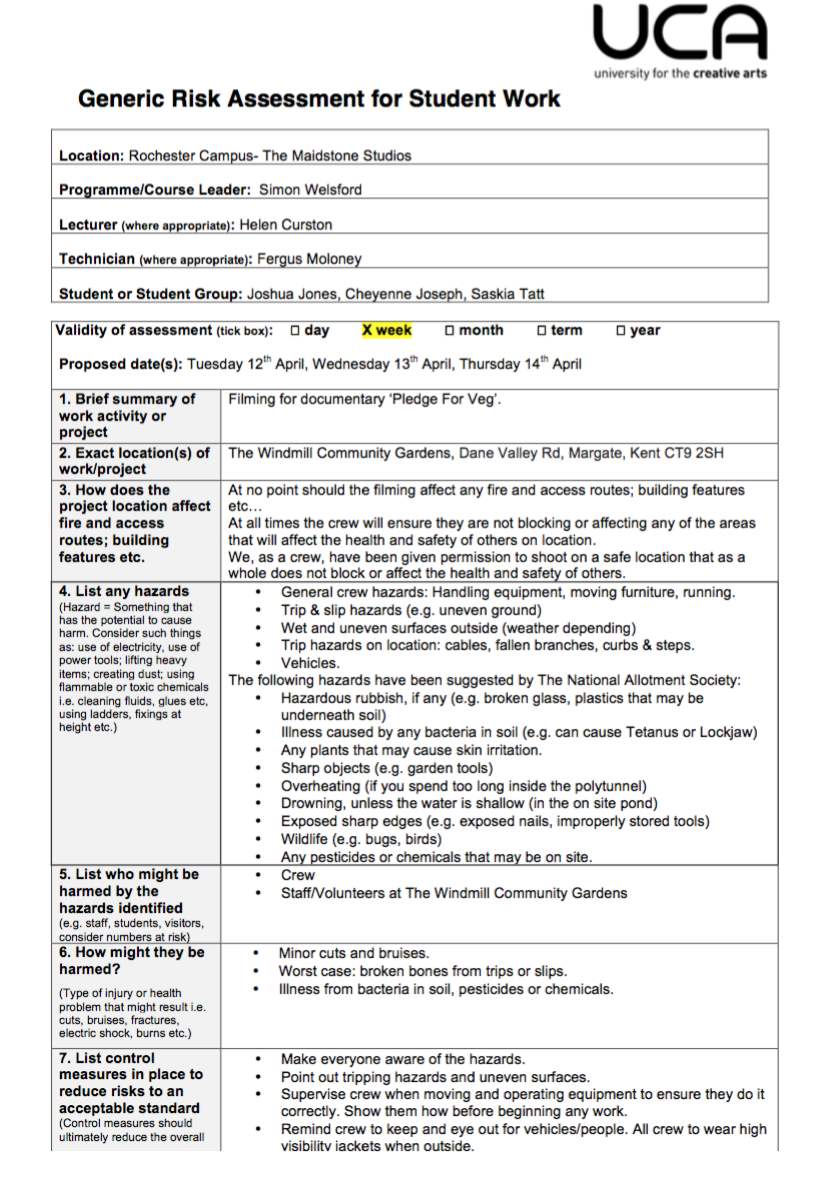
After my initial visit to our filming location, I put a risk assessment together to ensure everyone was safe during the production of our documentary.

RISK ASSESSMENTS

When I initially visited the location I kept some notes on any hazards I saw on the allotments. I also asked one of the head growers on site about any hazards I needed to think about when writing the risk assessment. And finally, to prepare for the risk assessment, I also checked with the National Allotment Society, who list some hazards to consider on their website.

Here are some of the risks I noticed/discovered:

  • General crew hazards- handling equipment.
  • Uneven ground
  • Vehicles
  • Hazardous rubbish
  • Plants causing skin irritation
  • Wildlife
  • Illnesses caused by bacteria in the soil
Page 1
Page 2
After completing this risk assessment, I have decided that it will be safe to film on this location. I will now share this risk assessment with the rest of my group, and the staff/volunteers on the allotments.

Documentary: Questions For Filming

As part of the pre-production process for this unit, I wrote some questions to use when filming the on screen interviews for this documentary.

QUESTIONS FOR FILMING

Using the second draft of the script, I wrote some questions to ask our characters whilst filming. These questions are designed to get us the answers we need to effectively tell the story we are trying to tell. Some questions are aimed at specific characters, whilst others are aimed at everyone involved.

I have listed the questions below: